Should you build or buy an AI tool?
Compare existing software and custom development by workflow fit, ownership, and ongoing work.
Austin Tanner
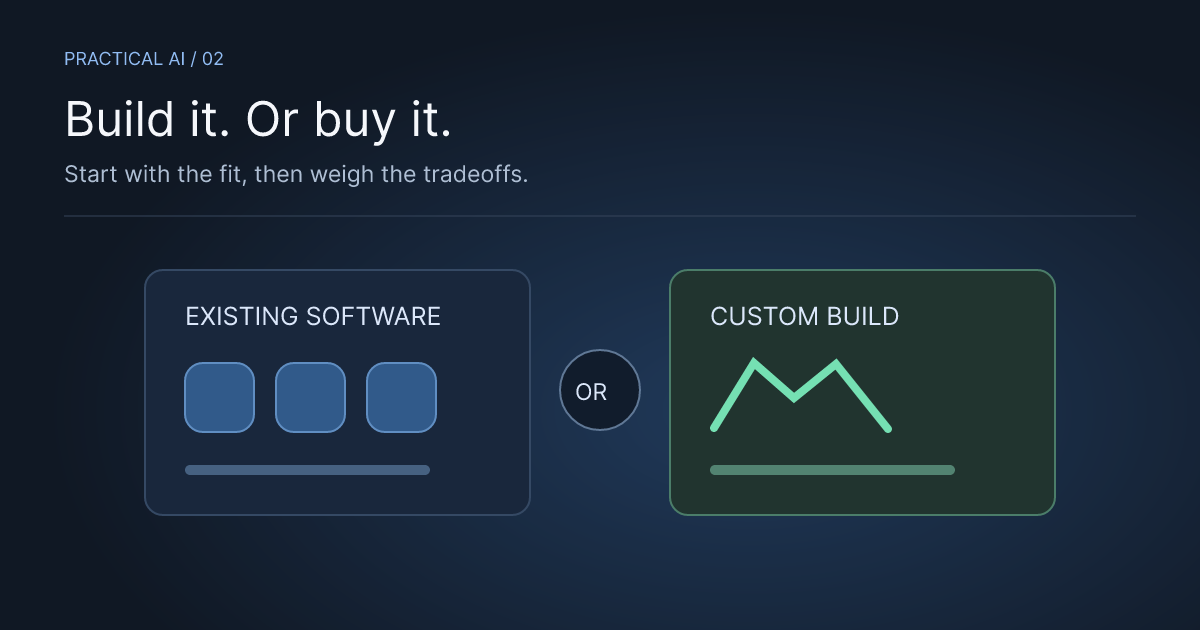
Start by seeing whether your existing tools already solve the problem. You may need a feature configured, a better process, or a small connection between systems. A custom build becomes useful when a specific gap remains.
Try the ordinary path first
Give an existing tool representative inputs and follow the work from beginning to end. Note where your team has to copy information, correct outputs, or work around a limitation.
Distinguish an inconvenience from a hard requirement. A different button layout may be acceptable. An inability to restrict access or export approved work may be a reason to choose another approach.
Compare the cost of operating it
Buying software still requires setup, training, account administration, and review. Building software adds development, deployment, maintenance, and responsibility for integrations.
List those costs separately. Include the work involved if you stop using the product or need to move your data. Do not compare a subscription price with a build quote as though they cover the same things.
Define the smallest custom scope
A custom build does not need to replace the whole system. It might be a document-processing step, a review interface, or a connection between two tools.
My Vibe Deck project addresses a specific interface problem: organizing multiple AI coding sessions. It provides a workspace around existing agents. It does not replace the agents themselves.
Make the decision reviewable
Write down the requirement, the approaches considered, the tradeoffs, and the reason for your choice. Agree on ownership, export access, third-party licenses, and who maintains any custom code.
You can use AI consulting to work through this decision before committing to development. If custom work makes sense, the next step is a written scope and quote for implementation.